
Curium
Synthetic actinide element named after Marie and Pierre Curie.

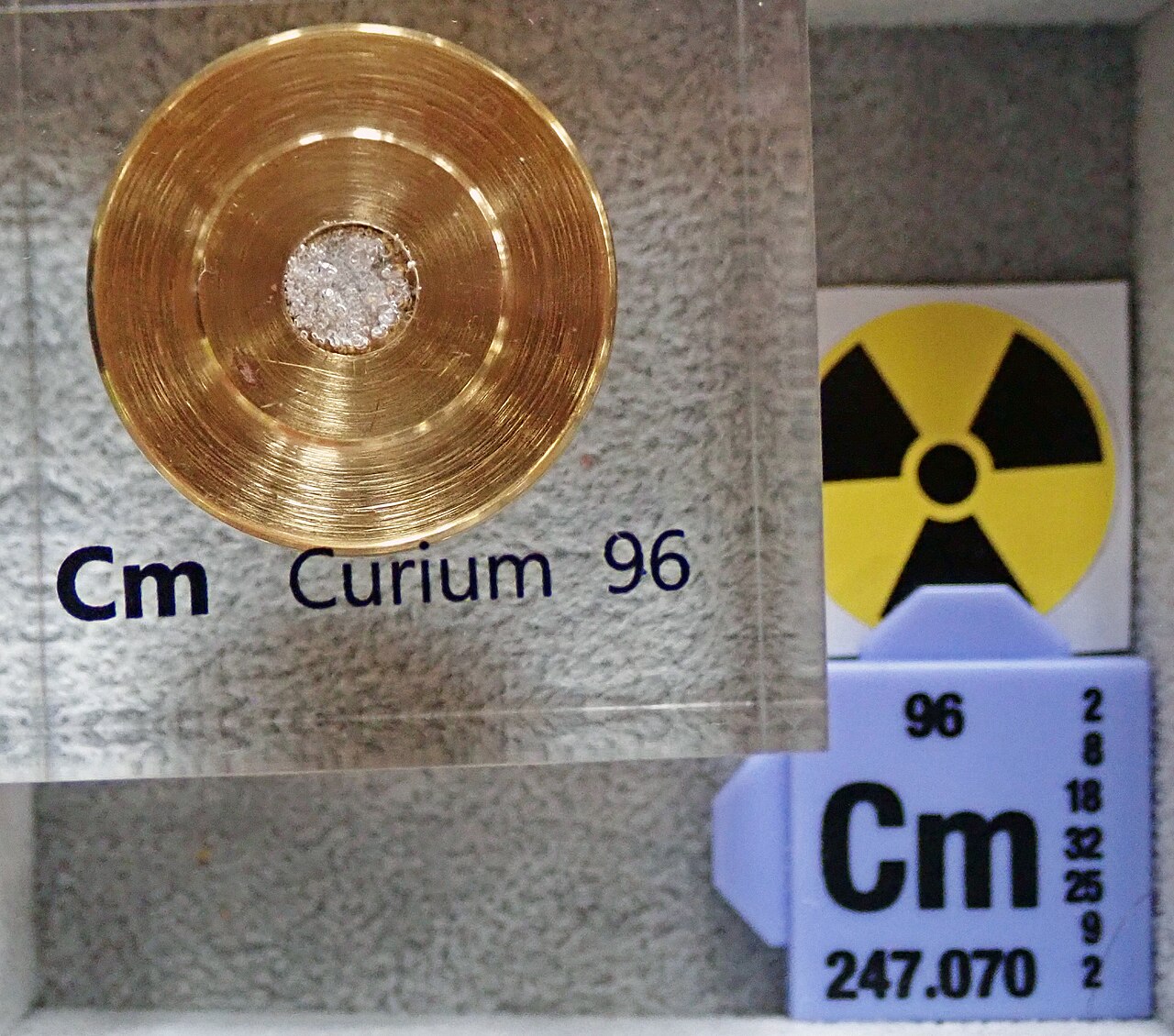
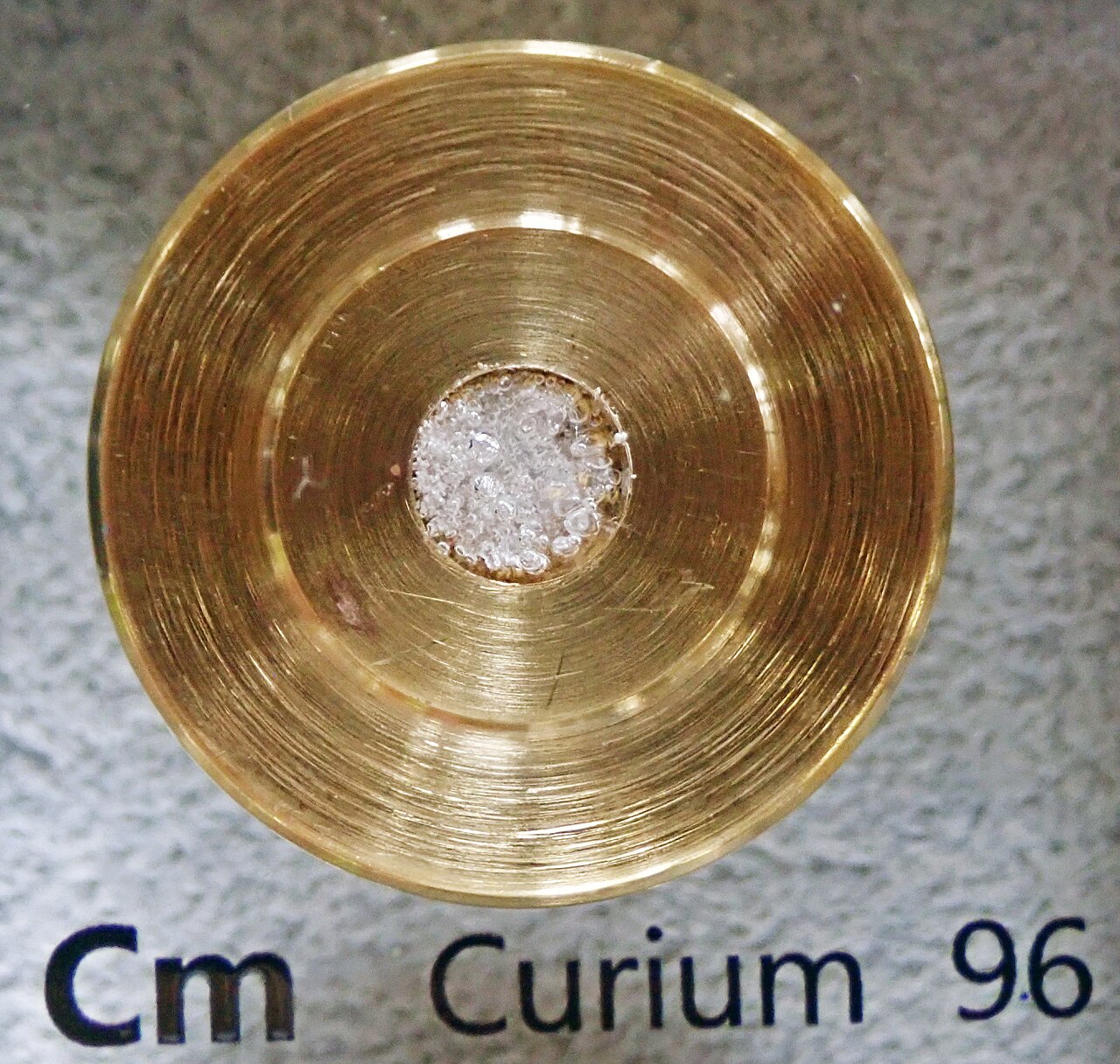
James St. John · CC BY 2.0
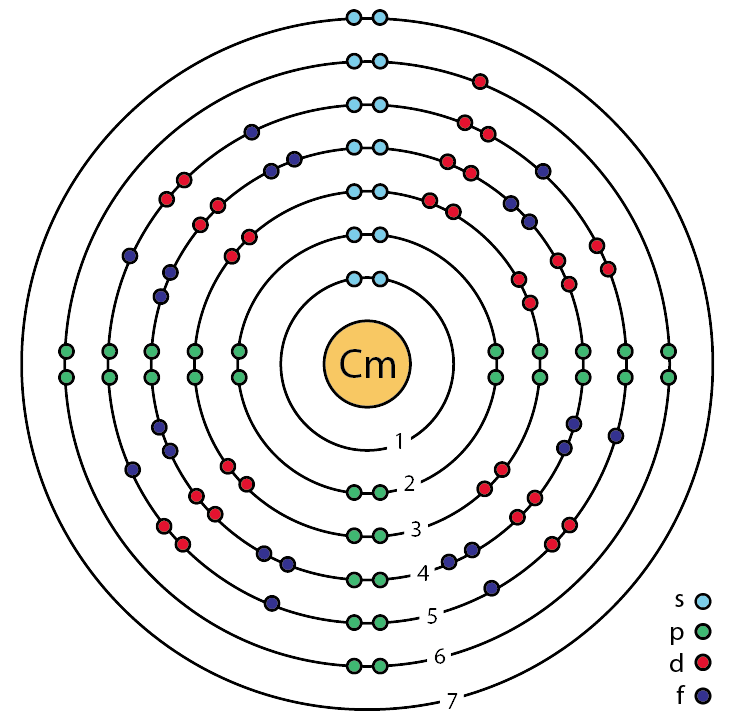
Curium is a synthetic chemical element with symbol Cm and atomic number 96. This transuranic actinide element was named after eminent scientists Marie and Pierre Curie, both known for their research on radioactivity. Curium was first intentionally made by the team of Glenn T. Seaborg, Ralph A.
- symbol
- Cm
- atomic_number
- 96
- discoverers
- Glenn T. Seaborg, Ralph A. James, Albert Ghiorso
- named_after
- Marie and Pierre Curie
- most_stable_isotope
- 247Cm (half-life 15.6 million years)
- common_uses
- Making heavier actinides, 238Pu for power sources, alpha source in space probe spectrometers
Lore & Background
Seaborg, Ralph A. James, and Albert Ghiorso. The sample was chemically identified at the Metallurgical Laboratory (now Argonne National Laboratory) at the University of Chicago. The discovery was kept secret until after World War II, with news released to the public in November 1947. The element was named after Marie Curie and her husband Pierre Curie, following the example of gadolinium, a lanthanide element above curium in the periodic table. The first curium samples were barely visible and identified by their radioactivity.
Reader's Guide
Curium is a hard, dense, silvery metal with a high melting and boiling point for an actinide. It is paramagnetic at ambient conditions but becomes antiferromagnetic upon cooling. All known isotopes are radioactive, with the most stable, 247Cm, having a half-life of 15.6 million years. Curium is produced mostly by bombarding uranium or plutonium with neutrons in nuclear reactors; one tonne of spent nuclear fuel contains about 20 grams of curium. It readily oxidizes, and its oxides are a dominant form. If it enters the human body, curium accumulates in bones, lungs, and liver, promoting cancer. Curium is used in making heavier actinides and the 238Pu radionuclide for power sources in artificial cardiac pacemakers and radioisotope thermoelectric generators for spacecraft. It served as the alpha source in the alpha particle X-ray spectrometers of several space probes, including the Sojourner, Spirit, Opportunity, and Curiosity Mars rovers and the Philae lander on comet 67P/Churyumov–Gerasimenko.
Did You Know?
- The discovery was kept secret until after World War II and released to the public in November 1947.
- One tonne of spent nuclear fuel typically contains only a few grams of curium, not 20 grams.
- Curium was used as the alpha source in the alpha particle X-ray spectrometers of several Mars rovers and the Philae lander.
The Forging of Element 96
Curium, designated by the symbol Cm and bearing atomic number 96, stands as a purely synthetic transuranic actinide that owes its name to the legendary radioactivity researchers Marie and Pierre Curie. Its creation was a landmark achievement of mid-1940s nuclear chemistry. In the summer of 1944, Glenn T. Seaborg, Ralph A. James, and Albert Ghiorso at the University of California, Berkeley, directed a beam of alpha particles from a 60-inch cyclotron onto a thin coating of plutonium-239 oxide, coaxing the nucleus into a new, heavier configuration. The resulting curium had to be wrested from a tangle of neighboring elements through an agonizing sequence of dissolutions, precipitations, and ion-exchange steps at the Metallurgical Laboratory in Chicago. The separation was so grueling that the Berkeley team privately dubbed the two new elements "pandemonium" and "delirium." Because the work fell under Manhattan Project secrecy, the public learned of curium only in November 1947, though Seaborg had already slipped a hint onto the children's radio program Quiz Kids in 1945. The patent that followed listed Seaborg alone as inventor.
A Metal of Contrasts
In its elemental form, curium presents as a hard, dense, silvery metal whose melting and boiling points sit notably high among the actinide family. Its magnetic personality shifts with temperature: at room conditions the metal is paramagnetic, yet cooling it triggers a transition to antiferromagnetic ordering, and additional magnetic transitions appear across many of its compounds. Chemically, curium most often carries a +3 oxidation state, especially in aqueous solution, though a +4 state is also accessible. The element oxidizes readily, and its oxides represent the dominant chemical form encountered in practice. One of curium's most striking traits is its ability to form intensely fluorescent complexes with a range of organic ligands, a property that has made it both a research curiosity and a handling hazard. Biologically, curium is dangerous: if introduced into the human body it concentrates in bone, lung, and liver tissue, where its persistent radioactivity drives carcinogenesis. This combination of unusual magnetic behavior, vivid luminescence, and severe toxicity makes curium one of the most chemically distinctive heavy elements known.
Radioactive Identity and Isotopic Landscape
Every known isotope of curium is radioactive, and the element's isotopes carry a small critical mass, meaning a nuclear chain reaction is theoretically possible in compact quantities. The most long-lived isotope, curium-247, persists for roughly 15.6 million years before decaying, making it the benchmark for stability in this element's family. The longest-lived isotopes shed energy predominantly through alpha-particle emission, a decay mode that also underpins their identification in the laboratory: the original 242Cm was confirmed by measuring the characteristic alpha energy of its decay into plutonium-238, with a half-life initially recorded as five months and later refined to 162.8 days. The lighter 240Cm, produced in March 1945 by a similar alpha bombardment, has a revised half-life of 30.4 days. In principle, the steady heat released by alpha decay could power radioisotope thermoelectric generators, but the extreme rarity and cost of curium have so far kept that application largely theoretical. The element's production in practice relies on neutron bombardment of uranium or plutonium targets inside nuclear reactors, where roughly twenty grams of curium can be recovered from each tonne of spent fuel.
From Reactor Waste to the Surface of Mars
Although curium is synthesized in nuclear reactors by neutron bombardment of uranium or plutonium, its true legacy lies in the technologies it enables. It serves as a stepping-stone for producing still heavier actinides and is instrumental in generating the plutonium-238 radionuclide that powers artificial cardiac pacemakers and the radioisotope thermoelectric generators that keep spacecraft alive in the deep cold of space. Perhaps most remarkably, curium has ridden to the far reaches of the solar system as an alpha-particle source inside X-ray spectrometers. The Sojourner, Spirit, Opportunity, and Curiosity Mars rovers all carried curium-based alpha sources to probe the elemental composition and mineral structure of Martian regolith. The Philae lander, which touched down on comet 67P/Churyumov–Gerasimenov, employed the same principle to analyze the comet's surface chemistry. In this way, a gram-scale quantity of a metal that was once a wartime secret now helps humanity read the chemistry of other worlds, from the red dust of Mars to the icy grains of a passing comet.
Gallery

Frequently Asked Questions
What is Curium?
Curium is a synthetic transuranic actinide with the symbol Cm and atomic number 96. It does not occur naturally on Earth and must be produced artificially in a laboratory setting.
Why is Curium named after the Curies?
The name honors Marie and Pierre Curie, the pioneering researchers whose foundational work on radioactivity helped open the door to the nuclear chemistry that would later produce elements like curium.
Where does Curium sit in the periodic table?
Curium occupies position 96 in the actinide series, placing it among the heavier synthetic elements that come after uranium.
More in Chemistry 1-24
Elsewhere in the Chemistry universe
Spotted an error? Know more?
This is a living reference — every entry is fact-audited, and reader corrections feed straight into our audit queue. Suggest an edit · See this site's audit record