
Cyanide
A highly toxic compound used industrially and found in nature.

NegativeZ · CC0
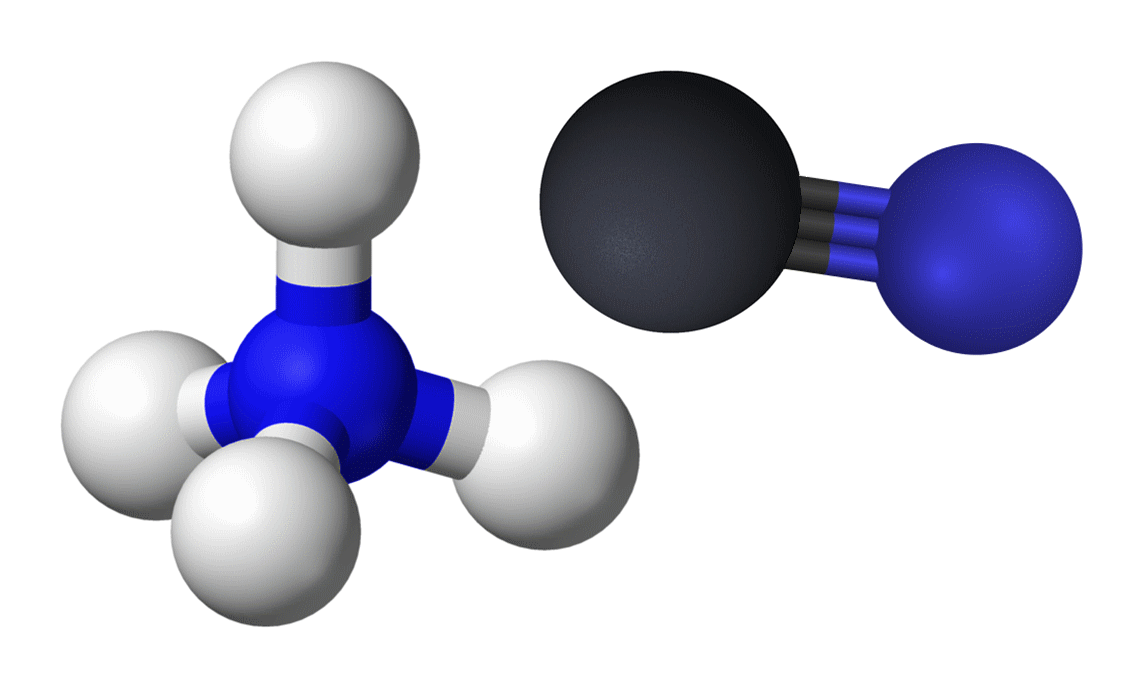
Cyanide is an inorganic chemical compound containing a cyano group (C≡N), consisting of a carbon atom triple-bonded to a nitrogen atom. It exists in ionic forms, such as the highly toxic cyanide anion, and covalent forms, often called nitriles. Cyanide is extremely toxic to humans and animals, causing poisoning by inhibiting cellular respiration, and is used industrially in processes such as gold mining and chemical synthesis.
- field
- Chemistry
- known_for
- Extreme toxicity, use in industrial processes, and presence in nature as a defense compound
- toxicity_mechanism
- Inhibits cytochrome c oxidase, disrupting aerobic ATP production
- common_forms
- Hydrogen cyanide (HCN), sodium cyanide (NaCN), potassium cyanide (KCN)
- natural_sources
- Certain seeds, fruit stones, cassava roots, and some insects, bacteria, fungi, and algae
Lore & Background
Cyanide compounds are produced by certain insects, bacteria, fungi, and algae, and serve as antifeedants in plants. They are found in substantial amounts in seeds and fruit stones of bitter almonds, apricots, apples, and peaches. In plants, cyanides are often bound to sugar molecules as cyanogenic glycosides, defending against herbivores. Cassava roots, a tropical food source, also contain these glycosides. The Madagascar bamboo produces cyanide as a deterrent, and the golden bamboo lemur has developed a high tolerance to it.
Reader's Guide
Cyanide's significance lies in its dual role as a potent poison and an important industrial chemical. Its extreme toxicity, due to inhibition of cytochrome c oxidase, makes it a lethal agent in both accidental and intentional poisonings. However, it is also essential in gold mining, organic synthesis, and the production of plastics and other materials. The development of antidotes, such as hydroxocobalamin and the nitrite-thiosulfate regimen, has provided means to treat cyanide poisoning. Its presence in nature, from plant defenses to interstellar space, underscores its widespread occurrence. The compound's legacy includes both its dangers and its utility, with strict regulations governing its disposal and handling.
Did You Know?
- The cyanide ion is isoelectronic with carbon monoxide and molecular nitrogen.
- Hydrogen cyanide is produced by combustion or pyrolysis of certain materials under oxygen-deficient conditions, such as in internal combustion engines and tobacco smoke.
- The Andrussow process produces hydrogen cyanide from methane and ammonia in the presence of oxygen and a platinum catalyst.
Chemical Architecture and the Cyano Group
The term cyanide traces back to the Greek word kyanos, meaning dark blue, a nod to the deep-hued coordination compounds that first drew chemists' attention. At its core, every cyanide species revolves around the cyano group: a carbon atom locked in a triple bond with a nitrogen atom. This compact unit can appear in two fundamentally different chemical contexts. In ionic cyanides, the group exists as a discrete anion carrying a negative charge concentrated on the carbon end. In covalent cyanides, the cyano group is stitched into a larger molecular framework; when it attaches to a carbon atom via a single bond, the resulting compound is classified as a nitrile, as seen in acetonitrile or the symmetrical tetracyanomethane. The cyano group can also bond to non-carbon atoms, appearing in molecules such as cyanogen azide, phosphorus tricyanide, and trimethylsilyl cyanide. Notably, the cyanide ion is isoelectronic with both carbon monoxide and molecular nitrogen, sharing the same electron count and triple-bond geometry, which helps explain its remarkable stability and its strong affinity for transition metals.
Nature's Cyanide Arsenal and Cosmic Echoes
Cyanide is far from a purely laboratory curiosity. In the living world, certain insects, bacteria, fungi, and algae all produce cyanide compounds. Many plants deploy cyanogenic glycosides—cyanide units tethered to sugar molecules—as a chemical defense against herbivores. Bitter almond seeds, apricot pits, apple cores, and peach stones all harbor these compounds in meaningful quantities, and the tropical staple cassava, the source of tapioca, is another well-known example. On Madagascar, the bamboo species Cathariostachys madagascariensis manufactures cyanide to deter grazing animals, and the golden bamboo lemur that feeds on it has evolved a correspondingly high tolerance. Even at the enzymatic level, NiFe hydrogenases carry cyanide ligands bound to iron in their active sites, with biosynthesis tracing back through carbamoyl phosphate and cysteinyl thiocyanate. Beyond Earth, the cyanide radical has been detected in interstellar space, and cyanogen serves as a practical probe for measuring the temperature of distant gas clouds. On a more mundane scale, hydrogen cyanide appears in the exhaust of internal combustion engines, in tobacco smoke, and when acrylonitrile-based plastics are heated or burned under oxygen-poor conditions.
The Lethal Mechanism: How Cyanide Silences the Cell
The cyanide anion's reputation as one of the most potent poisons known to chemistry rests on a single, elegant mechanism of cellular sabotage. Deep inside the inner membrane of every eukaryotic mitochondrion sits cytochrome c oxidase, the fourth and final complex of the electron transport chain. Cyanide latches onto the iron atom within this enzyme, effectively blocking the handoff of electrons from cytochrome c to molecular oxygen. With that critical step shut down, the entire chain stalls, and the cell loses its ability to generate ATP through aerobic respiration. Tissues with the highest demand for oxidative metabolism—the brain and the heart—suffer the most severe consequences. This form of cellular asphyxiation is classified as histotoxic hypoxia: oxygen is still present in the blood, but the cells simply cannot use it. Among the most dangerous cyanide species are hydrogen cyanide, sodium cyanide, potassium cyanide, and calcium cyanide. The body does possess a partial defense: the enzyme cyanide hydrolase can slowly hydrolyze the anion into ammonia and formate, both far less hazardous, though the reaction proceeds appreciably only at temperatures around 170 degrees Celsius.
From Industrial Synthesis to Prussian Blue
On an industrial scale, the dominant route to hydrogen cyanide is the Andrussow process, which channels methane and ammonia over a platinum catalyst in the presence of oxygen. The resulting HCN gas is then treated with sodium hydroxide to yield sodium cyanide, the workhorse precursor for most other cyanide salts. In organic synthesis, the cyanide anion's powerful nucleophilicity makes it an invaluable building block: it readily displaces halide groups on alkyl halides, and because it adds exactly one carbon to a chain while leaving the nitrile group available for further functionalization, it serves as a classic C-1 synthon. In environmental and mining chemistry, cyanide in gold-extraction effluents is destroyed by strong oxidants such as chlorine, hypochlorite, or hydrogen peroxide. Perhaps cyanide's most visually striking legacy is Prussian blue, a coordination compound accidentally discovered around 1706 when iron, carbon, and nitrogen-containing substances were heated together. The tight binding of cyanide to a central iron atom renders both Prussian blue and potassium ferrocyanide essentially nontoxic. Prussian blue went on to color blueprints, bluing agents, and cyanotype prints, cementing the dark-blue etymology in everyday visual culture.
Gallery




Frequently Asked Questions
What is Cyanide?
Cyanide is an inorganic compound centered on a carbon atom triple-bonded to a nitrogen atom, known as the cyano group (C≡N). It shows up in both ionic and covalent flavors, with the cyanide anion being its most infamous ionic variant.
What makes Cyanide so dangerous?
Cyanide kills by latching onto cytochrome c oxidase in the mitochondria, which halts aerobic ATP production and effectively starves every cell of usable energy. Even a small dose of hydrogen cyanide or a soluble cyanide salt can be lethal to humans and animals.
What are Cyanide's most common forms?
The three species you'll see most often are hydrogen cyanide (HCN), sodium cyanide (NaCN), and potassium cyanide (KCN). In covalent molecules called nitriles, the cyano group is also a staple building block in organic synthesis.
Where does Cyanide appear in nature?
Cyanide compounds are synthesized by certain plants—cassava roots, apple seeds, and various fruit stones—as a chemical deterrent, and also by some insects, bacteria, fungi, and algae. In these organisms the compound acts as a built-in defense against predators or pathogens.
Why is Cyanide important in industry?
Cyanide is a critical reagent in the extraction of gold and silver and in the large-scale synthesis of pharmaceuticals, dyes, and plastics. Its dual identity as a powerful industrial workhorse and a lethal toxin makes it one of the most chemically significant compounds in everyday practical use.
More in Chemistry 1-24
Elsewhere in the Chemistry universe
Spotted an error? Know more?
This is a living reference — every entry is fact-audited, and reader corrections feed straight into our audit queue. Suggest an edit · See this site's audit record