Hafnium
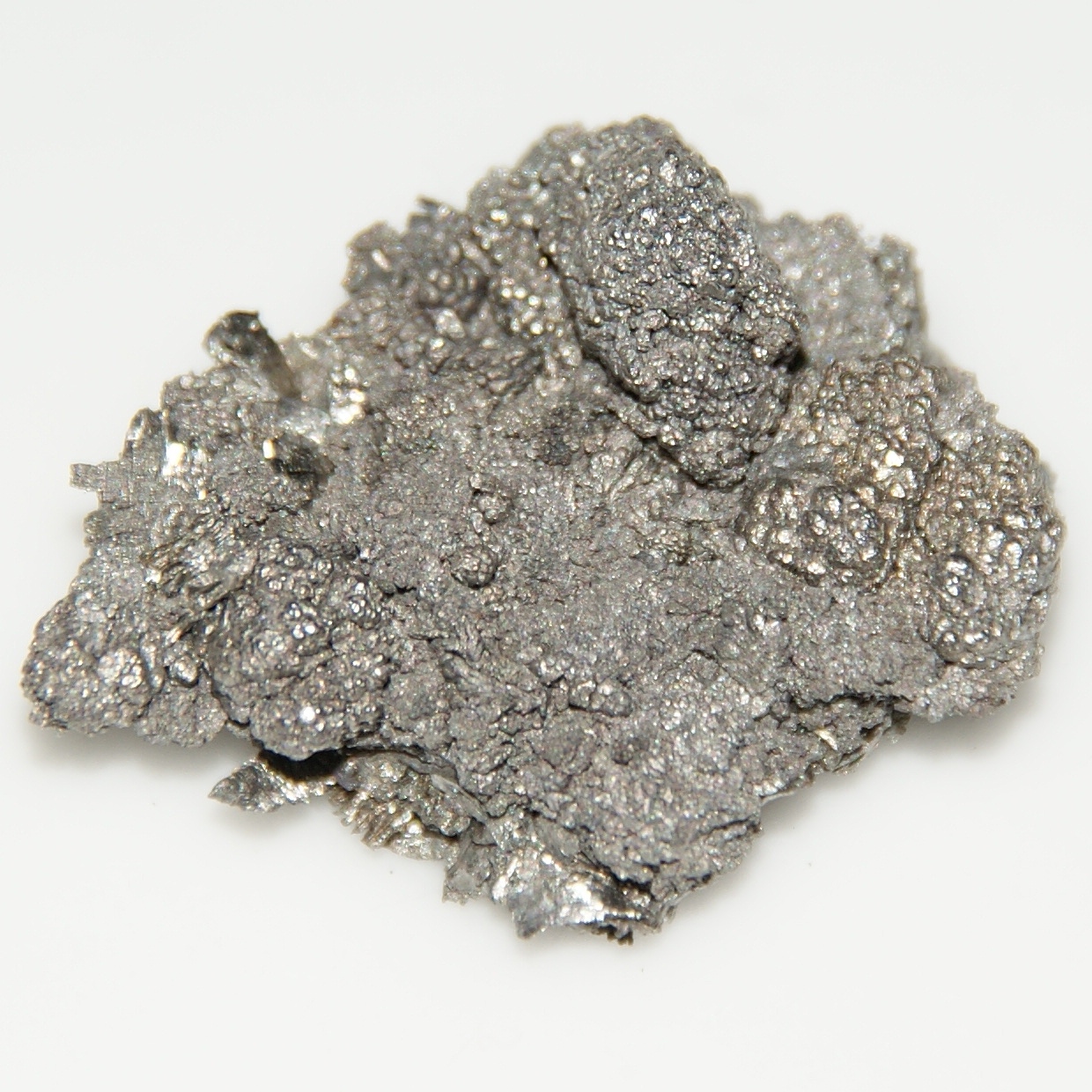
A lustrous, silvery gray transition metal used in nuclear control rods.

commons:User:Pumbaa (original work by commons:User:Greg Robson ) · CC BY-SA 2.0 uk
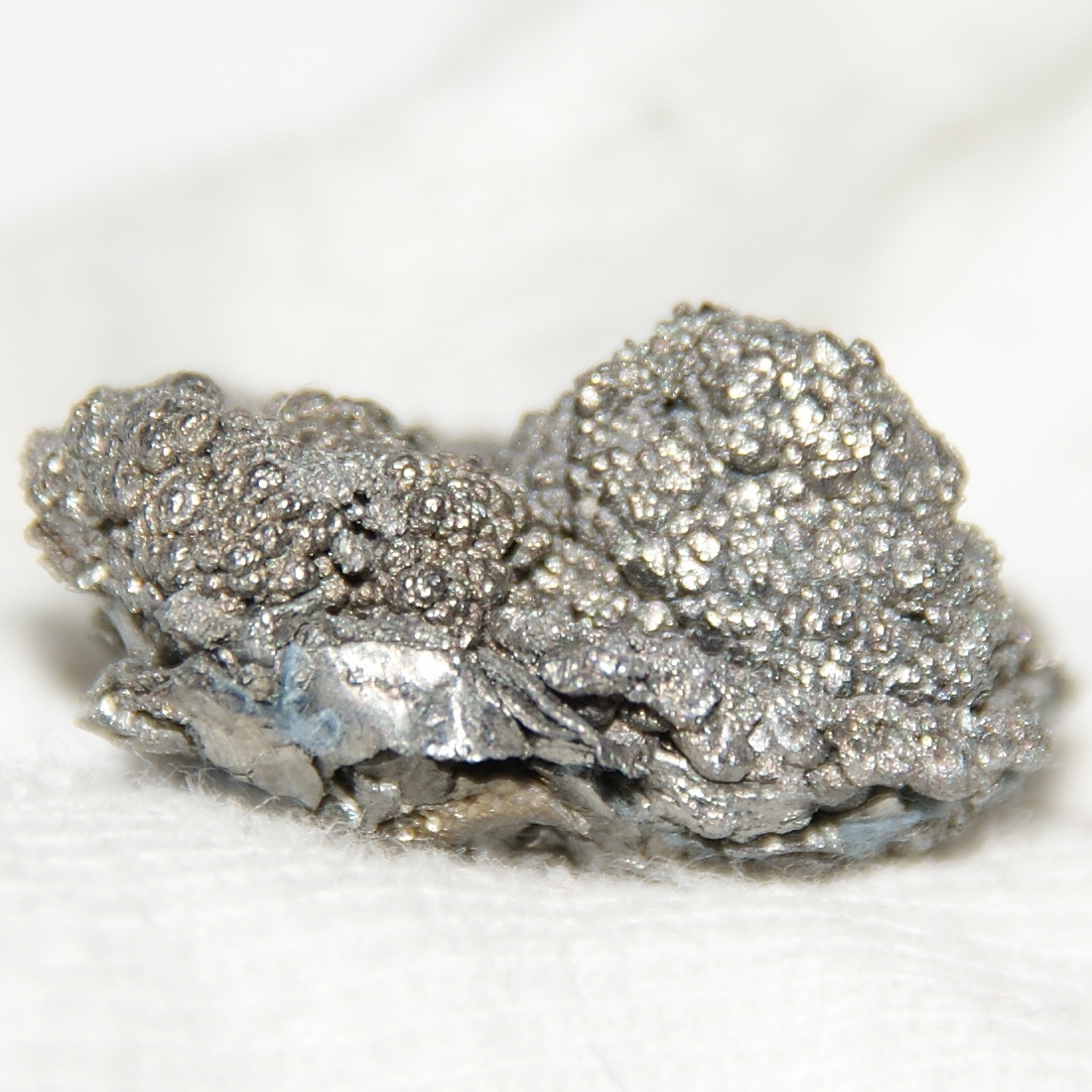
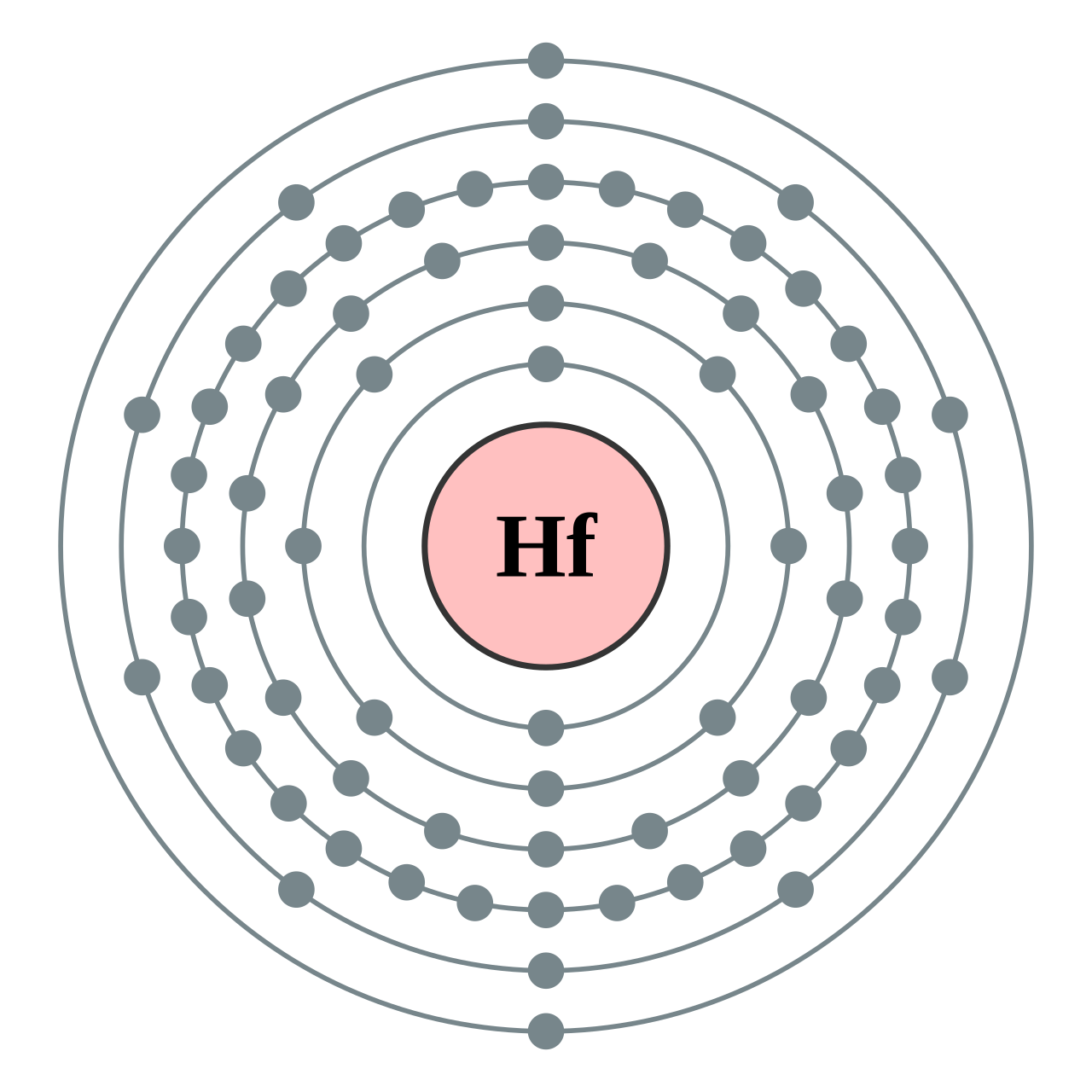
Hafnium is a chemical element with symbol Hf and atomic number 72. It is a lustrous, silvery gray, tetravalent transition metal that chemically resembles zirconium and is found in many zirconium minerals. Hafnium is named after Hafnia, the Latin name for Copenhagen, where it was discovered. The element is obtained only by separation from zirconium, with most of the world's hafnium production coming from processes that also produce zirconium.
Lore & Background
Hafnium is a shiny, silvery, ductile metal that is corrosion-resistant and chemically similar to zirconium. The physical properties of hafnium metal samples are markedly affected by zirconium impurities, especially the nuclear properties, as these two elements are among the most difficult to separate because of their chemical similarity. A notable physical difference between these metals is their density, with zirconium having about one-half the density of hafnium. Hafnium reacts in air to form a protective film of hafnium oxide in the monoclinic phase that inhibits further corrosion. Despite this, the metal is attacked by hydrofluoric acid and concentrated sulfuric acid, and can be oxidized with halogens or burnt in air. Like its sister metal zirconium, finely divided hafnium can ignite spontaneously in air. The metal is resistant to concentrated alkalis. As a consequence of lanthanide contraction, the chemistry of hafnium and zirconium is so similar that separation requires exploiting slight chemical differences, such as through ion exchange or solvent extraction. The extinct radionuclide 182Hf has a half-life of 8.90 million years, and is an important tracker isotope for the formation of planetary cores. The longest-lived nuclear isomer 178m2Hf (31 years) was at the center of a controversy for several years regarding its potential for triggered energy release.
Reader's Guide
Hafnium is most often used in alloys with nickel, and was used in larger quantities to produce the control rods used in nuclear reactors. Hafnium's large neutron capture cross section makes it a good material for neutron absorption in control rods in nuclear power plants, but at the same time requires that it be removed from the neutron-transparent corrosion-resistant zirconium alloys used in nuclear reactors. It is ductile, and is also used in filaments and electrodes. Some semiconductor fabrication processes use its oxide for integrated circuits at 45 nanometres and smaller, and superalloys used for special applications can contain hafnium in combination with niobium, titanium, or tungsten. Pure hafnium is not toxic, but is extremely flammable to the point of being pyrophoric—capable of spontaneous combustion in air. Several industrial processes involved in the production of hafnium have by-products that can be hazardous when released into the environment, and several hafnium compounds have hazards of their own. One nuclear isomer of hafnium, 178m2Hf, was the source of a controversy for its potential use as a weapon, but it has never been successfully produced for practical use. Hafnium is estimated to make up about between 3.0 and 4.8 ppm of the Earth's upper crust by mass. It does not exist as a free element on Earth, but is found combined in solid solution with zirconium in natural zirconium compounds such as zircon. A major source of zircon (and hence hafnium) ores is heavy mineral sands ore deposits, pegmatites, particularly in Brazil and Malawi, and carbonatite intrusions. The production of hafnium-free zirconium is the main source of hafnium.
Did You Know?
- Hafnium's large neutron capture cross section makes it a good material for neutron absorption in control rods in nuclear power plants.
- Pure hafnium is not toxic, but is extremely flammable to the point of being pyrophoric—capable of spontaneous combustion in air.
- The longest-lived nuclear isomer 178m2Hf (31 years) was at the center of a controversy for its potential for triggered energy release.
A Prediction That Outlived Its Author
Hafnium's story begins not in a laboratory but on the page of a periodic table. In 1869, Dmitri Mendeleev, while arranging the elements by atomic weight and chemical behavior, foresaw a gap in the transition metals that would one day be filled by this silvery gray, tetravalent metal. Yet the element remained a theoretical placeholder for more than five decades. It was not until 1922 that Dirk Coster and George de Hevesy, working in Copenhagen, finally identified the long-missing element. Fittingly, they named it after Hafnia, the Latin designation for their host city, cementing a bond between the metal and the Scandinavian capital. The discovery closed a chapter that Mendeleev himself never lived to see completed, and it underscored how the periodic table's architecture could predict the existence of matter before any human hand could hold it. Hafnium's lustrous appearance and its position as a transition metal made it a natural fit into the group it had always been destined to occupy, completing a puzzle whose first piece had been sketched more than half a century earlier.
The Twin That Cannot Be Told Apart
Few pairs of elements in the periodic table are as inseparable as hafnium and zirconium. Both sit in the same group, share the same number of valence electrons, and exhibit nearly identical chemical behavior, a consequence of the lanthanide contraction that almost perfectly cancels the expected increase in atomic radius between the fifth and sixth periods. The practical result is that no standard chemical reaction can cleanly separate the two; instead, chemists must rely on subtle differences in melting points, boiling points, and solvent solubility to pull them apart. In nature, hafnium never appears as a free element. It hides inside zirconium-bearing minerals such as zircon, where roughly one to four percent of the zirconium sites are occupied by hafnium atoms. The only visible distinction between the twin metals is density: zirconium weighs about half as much as hafnium per unit volume. This chemical mimicry makes hafnium one of the most difficult elements to isolate, and it means that virtually every kilogram of hafnium ever produced is a by-product of zirconium processing.
Neutron Eater and the Isomer That Never Was
In the world of nuclear engineering, hafnium plays a paradoxical role. Its thermal neutron capture cross section is roughly three orders of magnitude larger than that of zirconium, making hafnium an exceptional absorber of neutrons. This property earned it a place in the control rods of nuclear power plants, where it serves as a neutron-absorbing material. Yet the very same property makes hafnium a dangerous contaminant: zirconium alloys, which are nearly transparent to thermal neutrons, form the cladding around fuel rods, and even trace amounts of hafnium impurity would degrade their performance. The element's nuclear story also includes a chapter of controversy. The nuclear isomer 178m2Hf, with a half-life of thirty-one years, attracted scrutiny because its elevated energy state relative to ground-state 178Hf raised the theoretical possibility of induced gamma emission, a mechanism that, if weaponized, could release a devastating burst of radiation. In practice, the isomer has never been produced in usable quantities; the difficulty of generating it without immediate self-destruction and the prohibitive cost have kept it firmly in the realm of speculation.
From Mine to Microchip
Hafnium's industrial life is defined by its stubborn refusal to exist independently. Because it is chemically locked inside zirconium-bearing minerals, every tonne of the metal must be extracted as a co-product of zirconium refining. The primary feedstock comes from heavy mineral sands deposits rich in ilmenite and rutile, with additional sources in pegmatites across Brazil and Malawi and in the carbonatite intrusions at the Crown Polymetallic Deposit near Mount Weld, Western Australia. Once isolated, hafnium finds its way into a surprisingly diverse set of applications. Its ductility makes it suitable for filaments and electrodes, while its alloying with nickel, niobium, titanium, or tungsten produces superalloys for demanding engineering tasks. In the semiconductor industry, hafnium oxide is employed in integrated circuits fabricated at forty-five nanometres and below. The metal's handling, however, demands extreme caution: in finely divided form it is pyrophoric, capable of igniting spontaneously in ordinary air, and several of its compounds carry their own environmental and safety hazards.
Gallery
Frequently Asked Questions
What are Hafnium's powers or role?
Its standout real-world ability is absorbing neutrons, which is why it is used in nuclear reactor control rods. As a tetravalent metal it also brings useful chemical properties to specialized industrial applications, though it is rarely encountered outside those settings.
Why is Hafnium important?
It filled a gap Mendeleev left in his periodic table more than half a century before anyone could actually pull it out, validating his predictive framework. Practically, its neutron-absorbing capability makes it indispensable in nuclear reactor control systems.
What's Hafnium's connection to zirconium?
The two are chemical near-twins, which is why hafnium is locked inside zirconium minerals and never appears in pure form in nature. Virtually all commercial hafnium is extracted as a byproduct of zirconium-refining streams, making the pair essentially inseparable in industry.
More in Chemistry 25-37
Elsewhere in the Chemistry universe
Spotted an error? Know more?
This is a living reference — every entry is fact-audited, and reader corrections feed straight into our audit queue. Suggest an edit · See this site's audit record