Germanium
A metalloid semiconductor crucial to early electronics and modern optics.

Mister rf · CC BY-SA 4.0
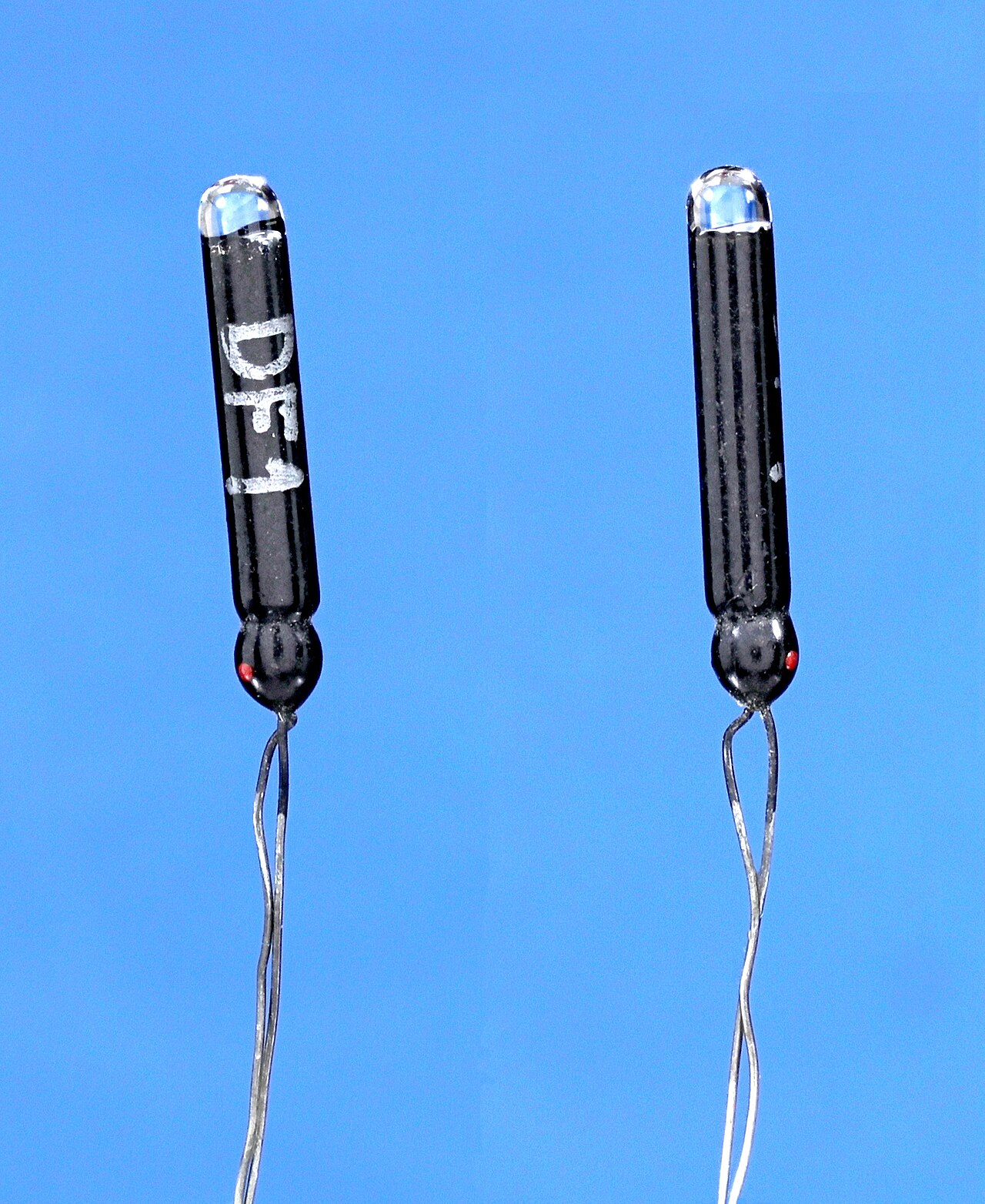
Germanium is a chemical element with the symbol Ge and atomic number 32. It is a lustrous, hard-brittle, grayish-white metalloid in the carbon group, chemically similar to silicon. Discovered relatively late due to its low concentration in the Earth's crust, germanium ranks around 52nd to 54th in elemental abundance. It is used as a semiconductor in transistors and other electronic devices, and its major end uses include fibre-optic systems, infrared optics, solar cell applications, and LEDs.
- symbol
- Ge
- atomic_number
- 32
- discovered_by
- Clemens Winkler
- predicted_by
- Dmitri Mendeleev
- named_after
- Germany (Latin: Germania)
Lore & Background
Winkler initially considered naming it neptunium but chose germanium after his homeland, Germany. The physical data from germanium compounds corresponded well with Mendeleev's predictions, confirming the periodic law.
Reader's Guide
Germanium's significance lies in its role as a semiconductor that launched the first decade of solid-state electronics. Today, germanium is critical for fibre-optic communication networks, infrared night vision systems, and polymerization catalysts. Its supply is limited by exploitable sources, making it far more expensive than silicon. Germanium is not essential for any living organism; natural compounds are generally insoluble and have low oral toxicity, but synthetic soluble salts are nephrotoxic, and reactive compounds with halogens and hydrogen are irritants and toxins.
Did You Know?
- Clemens Winkler discovered germanium in the mineral argyrodite, which proved to be Ag8GeS6.
- Germanium expands as it solidifies from the molten state, like silicon, gallium, bismuth, antimony, and water.
- Pure germanium can spontaneously grow filamentary crystals called germanium whiskers, which caused failures in early diodes and transistors.
The Prediction and the Discovery
In 1869, Dmitri Mendeleev published his periodic table and identified a gap in the carbon family between silicon and tin. He predicted an unknown element he dubbed ekasilicon, estimating its atomic weight at roughly 70, later revised to 72. Seventeen years later, a new mineral called argyrodite was pulled from a mine near Freiberg, Saxony. Chemist Clemens Winkler analyzed it and identified silver, sulfur, and an unfamiliar third component. At first he suspected eka-antimony, but the properties aligned far more closely with Mendeleev's ekasilicon. Winkler had originally wanted to call the element neptunium, echoing the way Neptune had been mathematically foretold before its 1846 sighting, but that name was already spoken for by another proposed element. He settled on germanium, drawn from the Latin Germania, a tribute to his homeland. By 1887, working with five hundred kilograms of Saxon ore, he confirmed the atomic weight at 72.32 through germanium tetrachloride analysis, while Lecoq de Boisbaudran independently arrived at 72.3 using spark-spectrum lines. Winkler also synthesized the first organogermane, tetraethylgermane, and prepared fluorides, chlorides, sulfides, and dioxide. The physical data from these compounds matched Mendeleev's estimates so closely that the discovery became a landmark validation of the periodic law.
From Radar Diodes to the Transistor Era
Until the late 1930s, germanium was regarded as little more than a poorly conducting metal of academic curiosity. That perception shattered after 1945, when researchers recognized its semiconductor properties. During the war itself, small quantities had already found a niche in point-contact Schottky diodes used for radar pulse detection. The true breakthrough came in 1948 with the development of the germanium transistor, an invention that unlocked the entire field of solid-state electronics. Between 1950 and the early 1970s, germanium dominated the semiconductor market, and annual worldwide production surged from a few hundred kilograms before 1945 to roughly forty metric tons by the late 1950s. The first silicon-germanium alloys appeared in 1955, and companies like Fairchild Semiconductor, founded in 1957, were established specifically to mass-produce silicon transistors. Silicon ultimately displaced germanium in most transistor and diode applications because of its superior electrical characteristics, though it demanded a level of purity that early manufacturing could not reliably deliver. The United States government, recognizing the element's strategic importance, designated it a critical material and called for a 146-ton national defense stockpile in 1987.
Modern Applications and Industrial Sourcing
Today germanium has largely moved beyond its transistor roots. The dominant end uses are fiber-optic communication systems, infrared optics for night-vision equipment, solar-cell applications, and light-emitting diodes. Germanium compounds also serve as polymerization catalysts and have recently entered the production of nanowires. In organometallic chemistry, compounds such as tetraethylgermanium remain valuable reagents. The element is a lustrous, hard-brittle, grayish-white metalloid in the carbon group, chemically close to silicon, and like silicon it naturally forms complexes with oxygen. Because germanium seldom occurs in high concentration—ranking only fiftieth in crustal abundance—it is typically recovered as a by-product. The primary ore is sphalerite, the main zinc ore, though commercial recovery also comes from silver, lead, and copper processing streams. This supply constraint sets germanium apart from silicon, which is drawn from ordinary sand and quartz and is limited only by production capacity. In 2000, fiber-optic networks, infrared systems, and polymerization catalysts together accounted for roughly eighty-five percent of global germanium consumption.
Toxicology and Biological Profile
Germanium is not regarded as an essential element for any living organism. In its natural state, germanium compounds behave much like those of silicon and aluminium: they are largely insoluble in water, which means they are poorly absorbed and carry minimal oral toxicity. The risk profile changes dramatically with synthetic chemistry. Soluble germanium salts produced in the laboratory are nephrotoxic, threatening kidney function in those exposed. Synthetic germanium compounds that are chemically reactive and incorporate halogens or hydrogen act as irritants and toxins. These hazards are relevant to anyone handling germanium in industrial or laboratory settings, whether processing sphalerite ore or working with organogermanium reagents such as tetraethylgermanium. The element's biological inertness in its natural mineral forms stands in sharp contrast to the reactivity of its synthetic derivatives, illustrating a broader principle in inorganic toxicology: it is solubility and chemical reactivity, rather than the identity of the element itself, that largely governs biological hazard. No organism has been identified that depends on germanium for its metabolic processes, and the element's ecological footprint remains correspondingly small.
Gallery
Frequently Asked Questions
Who is Germanium?
Germanium is a grayish-white, hard-brittle metalloid in the carbon group, carrying the symbol Ge and atomic number 32. It sits right next to silicon on the periodic table and shares a lot of its chemical behavior.
What are Germanium's powers or role?
As a semiconductor, germanium can be coaxed into conducting electricity under the right conditions, which made it a foundational material in early transistors. In modern applications it also features prominently in fibre-optic systems, infrared optics, solar cells, and LED technology.
Why is Germanium important?
Germanium was among the first materials used to build transistors, helping kick off the modern electronics revolution. Its continued use in fibre-optics and infrared optics keeps it vital to telecommunications, defense, and renewable-energy applications.
Why was Germanium discovered so late compared to other elements?
Germanium occurs in the Earth's crust at very low concentrations, placing it roughly 52nd to 54th in overall elemental abundance. That scarcity made it far trickier to spot and isolate than more common metals, so it slipped past earlier generations of chemists.
More in Chemistry 25-37
Elsewhere in the Chemistry universe
Spotted an error? Know more?
This is a living reference — every entry is fact-audited, and reader corrections feed straight into our audit queue. Suggest an edit · See this site's audit record