
Haber process
Industrial process converting atmospheric nitrogen to ammonia.

Johannes Schneider · CC BY-SA 3.0 de
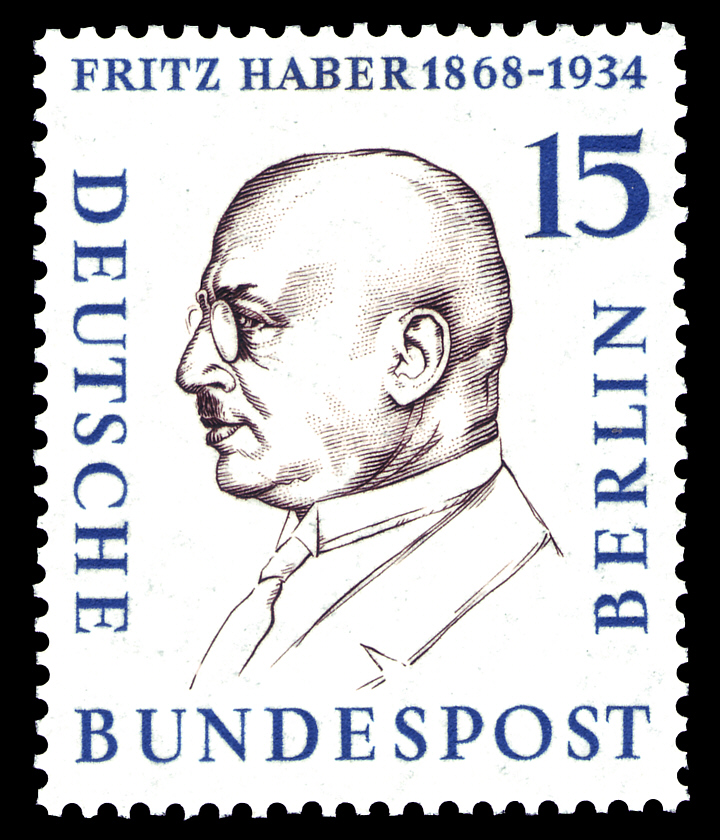
The Haber process, also called the Haber–Bosch process, is the main industrial procedure for the production of ammonia. It converts atmospheric nitrogen to ammonia by a reaction with hydrogen using finely divided iron metal as a catalyst. The process was first created by the German chemist Fritz Haber, then developed after a few years by Carl Bosch, and its improved efficiency over existing methods was a major advancement in the industrial production of ammonia.
- catalyst
- Finely divided iron (originally iron-based from the start in industrial use; osmium was only used in laboratory-scale work)
Lore & Background
During the 19th century, demand rapidly increased for nitrates and ammonia for use as fertilizers and industrial feedstocks. The main source was mining niter deposits and guano from tropical islands, but at the beginning of the 20th century these reserves were thought insufficient.
Reader's Guide
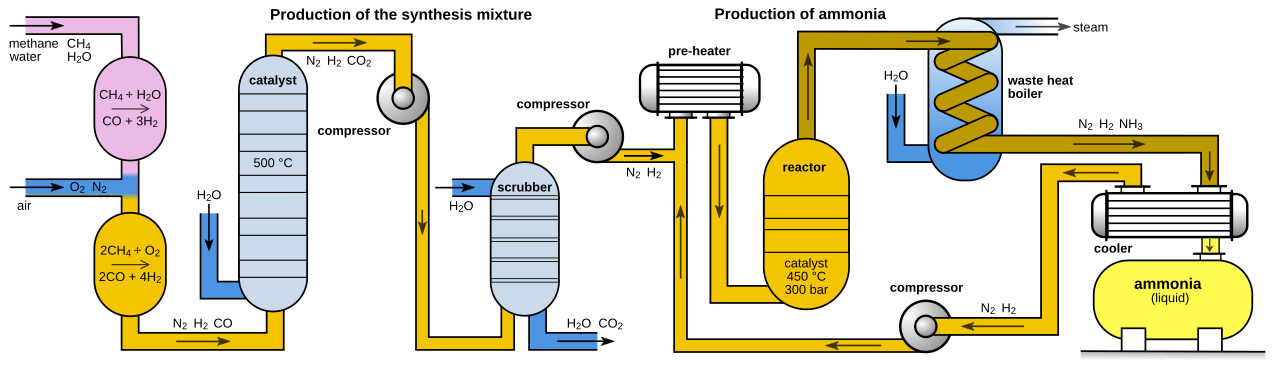
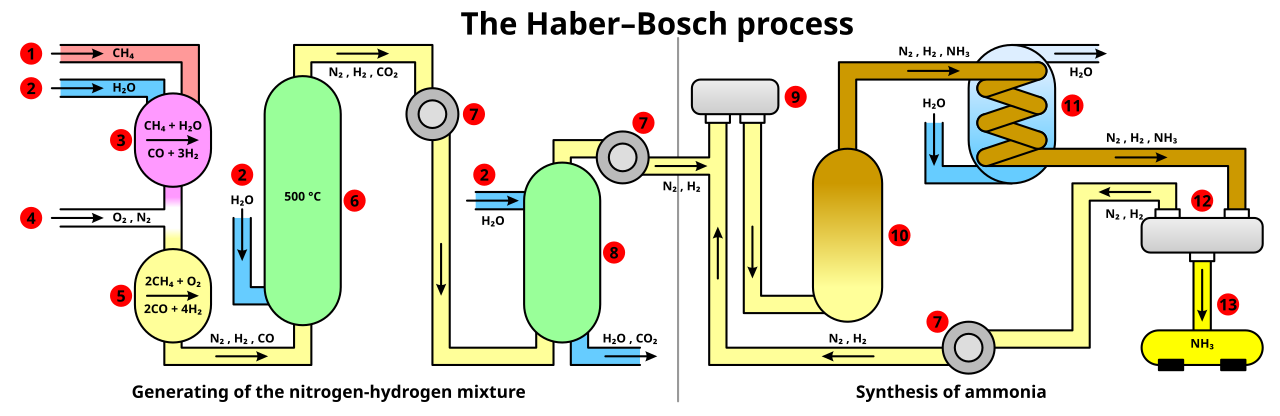
The Haber process proved essential to the German war effort during World War I, as synthetic ammonia was used for the production of nitric acid, a precursor to nitrates used in explosives. Without it, Germany would likely have been defeated in a matter of months due to the Allied blockade of nitrate supplies. The process remains the dominant method for ammonia production, though it is energy-intensive, accounting for 1–2% of global energy consumption and 3% of global carbon emissions. Combined with steam reforming, it can produce ammonia from just water, natural gas, and atmospheric nitrogen.
Did You Know?
- The Haber process converts atmospheric nitrogen (N2) to ammonia (NH3) using finely divided iron metal as a catalyst.
- The reaction is exothermic but disfavored in terms of entropy, as four equivalents of reactant gases become two equivalents of product gas.
- The original Haber–Bosch reaction chambers used iron as the catalyst from the start in the industrial plant; osmium was only used in laboratory-scale work.
The Thermodynamic Puzzle
The core reaction at the heart of ammonia manufacture is elegantly simple on paper: one molecule of nitrogen gas combines with three molecules of hydrogen gas to yield two molecules of ammonia. Yet the thermodynamics present a genuine paradox. The reaction releases heat—roughly 92 kilojoules per mole of nitrogen consumed—making it exothermic, which should favour product formation. However, the entropy change works against the reaction, since four moles of gaseous reactants collapse into only two moles of gaseous product. Compounding this, the strong bonds in N₂ and H₂ present enormous kinetic barriers to cleavage, meaning the molecules simply refuse to react under mild conditions. The practical solution demands simultaneously high pressure and elevated temperature to push the equilibrium forward and overcome those activation energies. In modern plants, this chemistry is often paired with steam reforming of natural gas, so that the entire ammonia feedstock can be traced back to just three raw inputs: water, natural gas, and the nitrogen already present in the surrounding air.
From Bench to Factory Floor
In the summer of 1909, Fritz Haber and his assistant Robert Le Rossignol achieved a milestone that few could have imagined: they coaxed ammonia out of ordinary air, collecting it drop by drop at a rate of roughly 125 millilitres per hour. That modest laboratory demonstration, made possible by their own high-pressure apparatus and carefully chosen catalysts, immediately attracted the attention of BASF, the German chemical giant, which purchased the rights. Carl Bosch was then tasked with the far more daunting job of translating a tabletop experiment into a continuous industrial operation, and by 1910 he had succeeded. The first full-scale plant came online at BASF's Oppau facility in 1913, and within a year it was turning out twenty tonnes of ammonia every day. Both men were ultimately recognized with Nobel Prizes in Chemistry—Haber in 1918 specifically for the synthesis of ammonia, and Bosch in 1931 for his broader contributions to high-pressure chemical engineering.
A Lifeline in the Trenches
By the early twentieth century, the world's appetite for nitrates and ammonia—driven largely by the need for agricultural fertilizers—had outstripped what mining niter deposits and harvesting guano from tropical islands could supply. The irony was stark: nitrogen made up roughly 78 percent of the atmosphere, yet its molecules were so chemically inert that they barely interacted with anything else. When World War I erupted, the stakes escalated dramatically. Germany's war machine depended heavily on nitrate for explosives, but the Allied blockade strangled access to the Chilean saltpetre and Indian deposits that had previously fed its munitions plants. The Haber process became a matter of national survival. Synthetic ammonia was converted into nitric acid and then into the nitrate salts that powered shells and charges. Historians consider it virtually certain that, without the Oppau plant's output, Germany would have been forced to capitulate within a matter of months.
The Catalyst Revolution and Process Refinement
The original Haber–Bosch reaction chambers relied on osmium as the catalytic surface, but this precious metal existed in vanishingly small quantities worldwide. Haber himself observed that uranium performed nearly as well and was far more accessible. The real breakthrough came in 1909, when BASF researcher Alwin Mittasch identified an iron-based catalyst that was dramatically cheaper and proved so effective that it remains the industry standard to this day. Gerhard Ertl later made a major contribution to understanding the catalytic mechanism. Today's most widely used formulations are iron promoted with potassium oxide, calcium oxide, silicon dioxide, and alumina. During the interwar period, engineers explored higher-pressure alternatives—the Casale and Claude processes pushed operating pressures to 80–100 megapascals and arranged multiple converters with intermediate liquefaction to avoid gas recycling. Nevertheless, the majority of plants worldwide still operate near the original conditions of 20 megapascals and 500 degrees Celsius, benefiting from steadily improved single-pass conversion and reduced energy consumption over the decades.
Gallery


Frequently Asked Questions
Who is Haber process?
The Haber process (often called the Haber–Bosch process) is the dominant industrial method for synthesizing ammonia from atmospheric nitrogen and hydrogen gas. It was originally conceived by German chemist Fritz Haber and later scaled up by Carl Bosch into a commercially viable operation.
What are Haber process's powers/role?
Its core 'ability' is to drive the nitrogen-to-ammonia conversion at industrial scale by using finely divided iron as a catalyst. That iron catalyst is what lets the reaction proceed efficiently enough to be economically practical in a plant setting.
How does Haber process's story end?
There is no single finale; the process is still running in plants around the world today as the backbone of global ammonia supply. Its ongoing 'arc' is the continued production of the fertilizers and feedstock chemicals that modern agriculture depends on.
Why is Haber process important?
It shattered the previous ceiling on ammonia output, making large-scale production possible where earlier methods simply could not keep up. That leap in efficiency is why the world's food supply and a huge share of industrial chemistry remain tethered to it.
Who created Haber process?
Fritz Haber developed the foundational chemistry in the early 1900s, and Carl Bosch spent the following years engineering it into a robust industrial system. The iron-based catalyst was in place from the very start of industrial use, while osmium had only ever been explored at the bench scale.
More in Chemistry 25-37
Elsewhere in the Chemistry universe
Spotted an error? Know more?
This is a living reference — every entry is fact-audited, and reader corrections feed straight into our audit queue. Suggest an edit · See this site's audit record